|
Do You Know How To Eat?
When people are trying to lose weight, most think about what they eat rather than how they eat. By making simple changes to the way you eat, you can avoid over-eating.
| 1. |
Slow Down
Almost everyone eats too fast. It takes 20 minutes before the stomach can tell the brain it is full, yet the average meal lasts only about 10 minutes. The result is that we eat far more than we need. |
| 2. |
Sit at the Table
Try not to eat cookies and chips while browsing in the pantry or grabbing a snack as these calories add up. Eat every single bite of food while sitting at the table. The extra effort will scare off weak cravings and allow you to see how much you are eating. |
| 3. |
Small Plates
A serving of food looks small on an oversized dinner plate. By using smaller plates, your serving sizes will tend to be smaller and therefore be more accurate. |
| 4. |
Only Eat from a Plate
Eating from bags, shared dishes (like chip or popcorn bowls), or straight from the container hides how much we are really eating. |
| 5. |
Move the Serving Dishes
Do not put serving dishes on the table - it is far too easy to have a second or third scoop. Leave the serving dishes in the kitchen. You can still have seconds, you just have to get up to get them. |
| 6. |
Eat Often
Eat less at meals but tell yourself you can go back in a few hours for more food if you need to. Have nuts, yogurt and fruit in between breakfast, lunch and dinner. |
| 7. |
Crave from a Plate at the Table
When you have cravings, first try to wait at least 5 minutes. If you are still craving the food, do the following: get a small plate, put a few bites of the craved item on the plate (no more than one serving, read the label), put the package away, take your plate to the table and eat your food without distraction. |
| 8. |
Liquid Calories
Watch the number of calories you drink, especially soft drinks, juices, and alcohol. |
| 9. |
Eat Better Desserts
Eat only the finest, most expensive desserts you can find and afford. You will eat less and enjoy them more. |
Core Training - Part 1
Nearly every movement of your body involves the use of your abdominals, obliques (muscles on the side of your body) and/or erector (back) muscles. These muscles are the core of all strength and power movements and are either involved in moving your torso or they work to stabilise your mid-section. Due to their involvement in every aspect of movement they undergo great amounts of stress and need to be conditioned regularly. The stronger these muscles are the more support and stability they can provide and the chance of injury will be reduced.
Below are the first series of core training exercises. These are all fairly basic and should be done 2-3 times per week.
The Hover
Lie face down with elbows resting on floor next to chest. Contract the abdominals and lift your body up with the elbows underneath the shoulders. The pelvis in conjunction with the spine and the knees should be in a straight line. Don't stick your butt up in the air or sag your lower back. Hold for about 10 seconds, with a 10 to 20 second recovery, eventually aim to hold for a minute. |
|
|
|
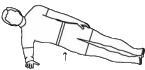
Side Hover
Lie on your right side with legs straight and one foot on top of the other. Place your right elbow directly under the right shoulder for support. Draw your lower abdomen inward toward your spine and lift your body up, keeping your body properly aligned. Hold for about 10 seconds, with a 10 to 20 second recovery, eventually aim to hold for 30 seconds. |
|
|
|
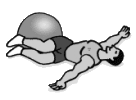
Russian Twist
Lie on your back, heels on the exercise ball, legs and hips at 90 degrees and arms out to the side on the floor. Slowly lower your legs and rotate your hips to the left towards the floor. Stop when your right shoulder comes off the floor. Slowly rotate your hips to the right towards the floor and stop when your left shoulder comes off the floor. The movements should be slow and controlled. |
|
Cholesterol
Cholesterol is a fatty substance found in our blood which stems from 2 sources: the liver (the body itself produces cholesterol) and our diet (eating foods high in fat).
Excess blood cholesterol levels can be related to health problems like angina and heart attacks. The reason is that fatty deposits are formed within the arterial walls which causes narrowing and a restriction of blood flow. However a small amount of cholesterol in our blood is essential. Cholesterol can help with the formation of membranes, steroids and other hormones and plays a role in the proper functioning of the nervous system.
There are 2 types of cholesterol: 'Good' and 'Bad'. Whether they are good or bad is dependant on how it is transported in the blood. The good cholesterol (HDL or High Density Lipoprotein) removes cholesterol from the arterial wall and slows, or may even prevent the development of plaque. On the other hand, LDL (Low Density Lipoprotein) actually transports cholesterol to the arterial wall where it is absorbed into the slowly growing plaque. This is what we need to try to prevent.
The safe level for cholesterol is:
| |
Total Cholesterol |
5.2 or less |
| |
LDL |
3.4 or less |
| |
HDL |
1.0 or higher |
So what can you do to help improve your cholesterol levels?
| 1. |
Decrease intake of fat, especially saturated fats. |
| 2. |
Increase intake of fibre (ie. wholemeal breads, cereals, fruit, vegetables and legumes). |
| 3. |
Increase intake of fish. |
| 4. |
Weight loss if overweight. |
| 5. |
Exercise. |
| 6. |
Avoid smoking. |
| 7. |
Choose monounsaturated fats (eg. Canola oil, olive oil and avocado in preference to others) but in minimal amounts. |
| 8. |
Medications prescribed by your doctor. |
Aerobic Training
Aerobic exercise is any repetitive activity that you do for long enough and hard enough to challenge your heart and lungs. To get this effect, you generally need to use your big muscles, including your legs, butt, chest and back and include activities such as walking, jogging, cycling, rowing and swimming.
If you don't have a heart rate monitor, the Perceived Rate of Exertion ("PRE") scale can be used to find out the level of intensity you are exercising. It uses a numerical scale (from 1 to 10) that corresponds to how you feel while you're exercising - the rate at which you perceive that you are exerting yourself.
| PRE |
HOW IT FEELS |
ACTIVITY EXAMPLE |
| 1 |
No effort |
Sleeping |
| 2 |
Very weak |
Watching TV, reading a book |
| 3 |
Weak |
Browsing in the shops, chatting with friends, typing on the computer |
| 4 |
Moderate |
Walking the dog |
| 5 |
Quite Strong |
Climbing up stairs, cycling for pleasure |
| 6 |
Strong: you are physically challenged |
Walking briskly, pushing a pram up a hill, digging in the garden, light jogging |
| 7 |
Tough: you feel like you can only carry on for a limited time |
Fast jogging or running, carrying and lifting heavy furniture |
| 8 |
Very tough: you have to force yourself to do this |
Running fast to catch the bus, circuit training, skipping |
| 9 |
Very, very tough: you are exercising at virtually your flat-out pace |
Running in a competitive race |
| 10 |
Maximum effort: you can work no harder |
Running for your life |
To work aerobically (and to benefit your heart and lungs), you should be exercising at a PRE level of between 6 and 8.
Food For Thought
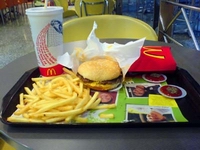
Quarter Pounder with large fries and
large Coke (total 1,226 calories) |
= |
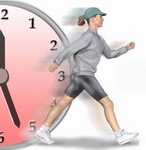
Walking for 250 minutes (based
on someone weighing 80kg) |
Nothing contained in this newsletter is intended to be used as medical advice and it is not intended to be used to diagnose, treat, cure or prevent any disease, nor should it be used for therapeutic purposes or as a substitute for your own health professional's advice.
|